Prayer
Prayer. What is it? Where does the concept of prayer come from? How do we do it?
Why do we do it?
Religious duty
Busy as we may be, we must keep up times of prayer. We must pray with all kinds of prayer, both social and solitary. We must pray confession of sin, for guidance, for thanksgiving. We must pray not for ourselves only, but for everybody; friends, enemies, strangers, the haves, the have nots.
And we must listen.
What is prayer?

Meditation is a medium through which we allow God to communicate with us. Prayer differs from meditation in that prayer is a dynamic conversation between our soul and God.
We might not be certain what our 'soul' is, and consequently not sure precisely how we can make this direct connection to God. So we use whatever method feels right and appropriate. Clearly our prayer must be sincere (Heb. 10:22) and with appropriate humility and reverence – we are, after all, unworthy sinners. And yet God, as we know, is willing to communicate with us. What an honour and privilege!
How we pray is for us to decide. The Bible does not lay down instructions, although it does offer plenty of models and guidance. Our religion, church, or spiritual leader may go further and suggest (even dictate) how we pray. During Mass or at other times, we may be directed to face the east. We may also be told when and even what to pray.
But prayer is from the soul and each individual is alone responsible for their own soul.
Prayer body language
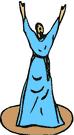
Outstretched arms (orans posture), traditionally a priestly gesture, but now also popular amongst charismatic laity.
For millions of Christians, using their hands to make the Sign of the Cross is an indispensable part of their worship. Postures become such an integral part of prayer that some people feel they are praying by just adopting a certain stance (see rituals for good luck).
Such positions have all passed down from the earliest of religions. King Solomon, for example, prayed kneeling with his hands spread out towards heaven.
Look at the street beggar or the refugees chasing after the relief food truck. All have eye contact and outstretched hands. Feed me, give me, I'm desperate, I'm needy.
Look at your pet dog or pigeons in the park begging for food. They also have eye contact and if they had hands, they would hold them out ready to catch anything thrown in their direction. These gestures seem to be natural, coming from deep within us. It is animal and human nature to express inward sentiment by outward sign.

Hands may be crossed over the chest ("Help me, I'm in pain"), or clasped like a Norman church steeple or with fingers interlocked. Whatever shape or form, clasped hands prevent us from fighting and this non-aggressive position shows submission.

Dhyana mudra
Early man would use a naturally-formed 'help me' sign when pleading, and as religions developed, the early Pagans assumed such postures when pleading with their god. The Christian's version just follows on from that. Sometimes with the outstretched 'Orans' posture, and sometimes with clasped hands, like the dhyana mudra used in Hinduism, Buddhism and other religions as a way to deliver a message to the mind/body energy system.
Prayer words
Just as milk seems to taste better from a glass than from a ceramic cup, so a prayer feels better if we use special words such as Amen.
Words are spoken aloud or considered silently, to our god. Man has prayed to the nature gods for millennia; it was certainly not a new invention for modern religions such as Christianity. And it was natural, like many other pagan ways, for Christians to adopt this form of communication with their God.
And finally...
Here's a 'bearly' credible story.
An atheist is walking alone through a thick forest, admiring all the nature that had evolved through the millennia, when suddenly he hears a noise behind him. Turning to look, he sees a huge grizzly towering over him. Heart thumping, he realizes that ready or not, his life is about to come to an abrupt and rather unpleasant end.
As the big bad bear roars and raises both front paws in the air, the atheist falls to his knees and screams, "Oh my God!"
Time immediately stands still. The birds and insects stop in mid-flight, the bear freezes as a statue [the big paws herald a big pause in this story...]. Nothing moves, except for the pounding of the atheist's heart. A bright light appears in the sky and God's voice booms down: "You have not believed in me all your life, yet now you cry out my name for help. In your final moments, do you now believe I exist?"
The atheist lowers his head in shame and admits quietly, "God, you are right. I am a sinner. It would be wrong of me to beg for forgiveness at this time. Forget it, and sorry to have troubled you." "I am a loving God" answers the voice, "but if you don't want my help, well, it's entirely up to you."
The atheist thinks for a while. "Perhaps you could make the bear a Christian? Then it will be a good bear and not harm me." he asks. "So be it!" says God.
Movement and sound resume. The bear gently lowers its paws, bows its head in prayer and says in a soft, reverent voice:
"Lord, for this food which I am about to receive, I am truly thankful."
Standing: Gen. 18:22, 19:27, 2 Chron. 20:13, 1 Sam. 1:26, Job 30:20, Luke 18:11, 13, Matt. 6:5, Mark 11:25
Kneeling: Gen. 17:3, 17, Num. 16:22, Josh. 5:14, 2 Chron. 20:18, Luke 22:41, Acts 7:59, 60, 9:40, 21:5, Eph. 3:14.
1 Kings 8:22, 54, 2 Chron. 6:13
Orans: Latin for "one who prays"
But if those words are only from a prayer book and not from the soul, then it is not a prayer
See also the words found on a Prayer Cross