Pagan items adopted by Christianity
Paganism§ has a wider influence on our lives than we might think
§ By 'pagan', we are taking the widest definition of anything that is not monotheistic.
We also look at, but not necessarily share the view of, the 19th-century writer Thomas Inman, who is adamant that "Christianity certainly requires to be purged of its heathenisms". In Ancient Pagan and Modern Christian Symbolism, Inman says that just as symbols had a particular meaning and place in ancient religions, some of the same symbols have a particular meaning and place in today's Christianity.
This is not to say that the meanings are the same.
The Church
Many of today's customs used in the Church can be traced back to the 4th century, when Constantine permitted the process of converting the official religion of the Roman Empire from Paganism to Christianity.
Note the word 'converting'. Changing the sign on the door is a lot easier, quicker and cheaper than changing the whole building. Christianity was modelled on many customs that were familiar and acceptable to Jews and Pagans at that time, when religion and belief were intertwined with superstition.
This contrasts with today's norm – at least in economically advanced countries – where people now have greater access to education and science, and base their religious belief on reasoning rather than superstition. (See also Isn't religion simply glorified superstition?)
But don't misunderstand the use of the word 'converting'; the birth of Christianity was not merely a recycle job. There's little doubt that Early Christians adopted well-known customs to develop their religion and doctrine. To suggest otherwise is to say that the seeds sown by God for earlier faiths was a mistake.
By definition, God does not make mistakes.
Christianity
Even the word 'Christian' was coined by Pagans.
The first followers of Christ borrowed Jewish terms to describe themselves, such as 'believers' and 'disciples' (but in Hebrew, of course). Two of the early missionaries, Paul and Barnabas, went to work spreading the Gospel in the Pagan metropolis of Antioch, where the locals derisively called them 'Christians'.
Paul and Barnabas certainly wouldn't have disputed that they were indeed Christians and would have been quite pleased that the Romans made it the official name.
Religious symbols
Over-emphasizing the relevance and importance of religious symbols can lead to conflict.
Consider the tensions raised in France during 2004/5, following the banning conspicuous religious symbols that didn't blend into secular state schools. The 'headscarf issue' resulted in just a handful of school expulsions but more damagingly generated ill-feeling, divided the country and achieved nothing positive.
This was exacerbated in July 2010 by the French government Assembly overwhelmingly approving a bill banning burqas and niqabs in any public place. Syria also bans the niqab at universities and headscarves are banned at Turkish universities. Several other European and Middle Eastern countries have considered introducing laws that make walking around naked a less punishable offence than walking around fully clothed.
Jacques Cousteau (1910-1997)
Setting the law is, of course, the right of governments, and as with many laws, people get upset when they feel restrictions offend their particular cultural traditions. But far from being an example of a 'Clash of Civilizations', this could be more accurately described as an ignorance of civilizations, where too much emphasis has been placed on religious symbols, to the point that they are used as excuses for prejudicial, negative (or positive) discrimination.
And if we look into the origin of many symbols, we see they often have a shaky basis for being considered religious at all. The veil, mentioned above, is just one example.
The Origin of the Symbols
In his 1878 Essay on the Development of the Christian Doctrine John H. Newman wrote:
"The use of temples, and these dedicated to particular saints, and ornamented on occasions with branches of trees; incense, lamps and candles; votive offerings on recovery from illness; holy water; asylums; holy days and seasons, use of calendars, processions, blessings on the fields, sacerdotal vestments, the tonsure, the ring in marriage, turning to the east, images at a later date, perhaps the ecclesiastical chant, and the Kyrie Eleison, are all of pagan origin, and sanctified by their adoption into the Church."
It's interesting to note that John Newman was a Catholic prelate – this was not yet more Catholic-bashing by a Protestant.
Perhaps many customs and symbols came into Christianity via Judaism, rather than directly from Paganism. Nevertheless, let's consider what John Newman meant by 'origin':
Holiness
The word 'holy' may have been derived from the Old English hālig, which means 'wholeness', or the Old High German hulis, meaning 'holly', which was considered a sacred plant to Pagans.
Blessings
From the sprinkling of blood on the altar.
Calendars

Our way of measuring time (see hours, minutes and seconds) is based on an early Babylonian system, and our modern calendar is based on Pagan practices, astrology and mythology.
But whether we consider ourselves religious or not, we don't think of the calendar as a religious thing; it's merely a means to measure time, using things called days and months.
If someone believes a particular date (Easter, for example) has some mystical power, it is the value that person has placed on it. The same goes for the Bible, the cross, and all the other items adopted by Christians that have a Pagan origin.
Fish symbol

Sometimes called the 'Jesus Fish' because of its link to the ancient Greek Ichthys. Currently vogue, the fish symbol is not as widely recognised as a Christian symbol. It means nothing to most people and largely known only 'in-house'.
The fish is an ancient symbol used by other religions, such as Buddhism and Paganism. Our fish symbol page shows how Christians have hooked onto this symbol.
Pagan crosses

The cross is a remarkable shape. Usually just two intersecting lines, the symbol is used in mathematics, shows where people should stop at international border checkpoints, and stops (some) people parking their cars at the roadside. It's a kiss at the bottom of a love letter and it's a vote for a politician. A death cross in financial terms means a situation where long-term and short-term averages converge. The cross is used extensively in black magic and in innumerable religions.
The Cross – an Emblem of Christianity explains how this simple symbol has evolved from its Pagan roots. We explain how it has caused as much grief as it has comforted. A torture instrument, a threat to entire civilizations, and yet used as jewellery and sometimes worshipped. It has associations with illegal psychedelic drugs, BSE and bird flu, Prince Harry, hatred and despair, love, valour and heroism, World War I, World War II, the Crusades, the invasion of Iraq (again), mythology, Satan, and salvation.
Pagan clothing
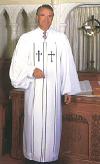
Vestments and fancy garb do not make the wearer a priest.
They have always been little more than symbols of status; a tradition passed down through civilization, and added to along the way.
Look at the ecclesiastical finery sported by high churches – those that emphasize formality and resist modernisation.
Some feel such distinction in the church is inappropriate but the tradition continues.
Church buildings and Pagan temples
The Early Church was not wealthy, and neither were Christians. The disciples were fishermen, artisans, peasants; not wealthy princes. Even if they wanted to build churches of their own design, there was no money for such a luxury. Therefore existing buildings were adapted.
When it was possible to build a new church, the design was usually in the form of an oblong, a cross or an ellipse (resembling the body of a fish or the hull of a boat). It was hardly ever circular, since that was the shape favoured by heathen religions. Nevertheless, the need for a special place for worship was recognised and the design, with some differences, was the osmosis of Pagan structures.
Those same basic layouts, well-intentioned though spiritually baseless, remain today.
Icon worship – idolatry and iconolatry
(This section is about icons created by man; not Christ, the icon of the invisible God Col. 1:15.)
Even today, there are Crusading 'Christians' who kill people, sincerely believing they are doing God's work whilst ignoring a basic Commandment "Thou shalt not kill". Consequently it's not surprising that most Christians ignore another: "Thou shalt not make to thee any graven image". (Jewish and Islamic laws about murder and idolatry are almost identical to Christian laws.)
This prohibition of idolatry is usually interpreted with some flexibility. Eastern Orthodox churches display icons; Roman Catholic churches contain statues; the pope hired Michelangelo; Protestant churches hang drawings; and almost all churches have one or more crosses.
Since pre-Christian times we have wanted to see God. But we cannot physically see into a different dimension, so we erect effigies of what we think God looks like. Or rather, we erect effigies of what we want God to look like, and that entices us to worship the effigies as idols.
An idol can be something coveted, like a statue, a cross, a Bible, a stained-glass window. It can be a deep green, ecological perspective of the earth; not far removed from Nature Worship.
Consider the millions of pilgrims, who for decades have touched the spiritual grotto at Our Lady of Lourdes in southern France. And since many have physically and spiritually benefitted from the visit, it's hardly surprising that people revere the place.
However, there is a grave danger that we push God to the side by placing undue attention and importance on idols.
If idols have any supernatural power at all, it must be the power to trick us into believing that we are not really worshipping them. The most popular idol does exactly that: The "Idollar". Without being aware, we sacrifice our time and energy, our family and friends, to the Idollar. Eventually we might discover that the money god doesn't love us or even like us, but usually we are oblivious to Idollartry [sic] and carry on worshipping it.
Candles

We've included candles on this page, but they don't in themselves have much of a Pagan origin, other than as a representation of light, goodness, spiritual healing, etc.
Candles are not often mentioned the Bible, since they didn't really match the lighting power of (olive) oil lamps in the Middle East until the 5th century.
Oil lamps were in use before Christianity, not only to replace darkness with light, but also to repel dark spirits. Only a superstition, yet quite natural and understandable behaviour. As children we prefer the light on at night to keep the bogeyman away.
Bells and bell ringing

A bell makes a sound – you probably knew that already. But they also do things that are much more important.
For example, the Liberty Bell in Philadelphia, USA, symbolises the nation's 18th century independence from Britain, the 19th century abolition of slavery, and the mid-20th century Cold War icon of God Bless America.
Such religious symbolism began in Paganism and has since been amplified by the Church.
Incense
Originally used to repel bad smells, the aroma from burning resin was used to dispel bad spirits.
Does this have any place in Christian worship?
Tonsure
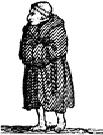
A monk with tonsure.
Balderdash (n.) a rapidly receding hairline.
The shaved head, in various styles, sported by monks and clerics of certain religious orders for hundreds of years has a simple origin.
Vow of Silence
St. Seraphim of Sarov is reputed to have said "Silence is the Cross on which we must crucify our ego" (but in Russian, of course), something that might have been easy when he was a solitary hermit, but soon he became extremely popular and many pilgrims visited him for guidance. He undoubtedly echoed the words widely attributed to St. Francis of Assisi; "Preach the gospel, and if necessary, use words."
Trappist Monks, famous for their contemplative silence, follow the Scriptures so that the voice of the world might be shut out and the voice of God might be heard.
But none of these Christian monks invented the idea.
Pythagoreans from around 530 B.C. took the practice of silence seriously; breaking the vow of silence carried the death penalty. And the priestess-guardians of the sacred Roman fire, the Vestal Virgins, lived in silence for years at a time.
Vidar, son of Odin was the Norse god of silence and there was a minor Roman goddess of silence called Muta, from which we get the word 'mute'.
Chants
Songs in the form of chants, poems, and later as hymns, cantatas, anthems, oratorios or motets, are useful mnemonic methods.
Singing makes us feel hearty and that's why we sing; whether it's a chant or any other form. Singing helps us feel young and energetic, even if we're not very proficient. Singing helps relieve tension. Singing is therapeutic. Communal singing turns an audience into participants.
Chanting has never been restricted to Christianity – Pagans used it as part of their worship too. Like the word Glory, chants are not even restricted to religion. They are used by squads of jogging soldiers, team-sports players in training, supporters at a match, cheerleaders, political convention crowds, children singing the Alphabet song and reciting nursery rhymes (not unlike political convention crowds).
One particular type of Christian hymn is called a carol, which is sung at Christmas time; another custom with Pagan roots:
Christmas
Christmas is one of the biggest events on the Christian calendar, yet the customs we associate with the event are steeped in Paganism.
Prayer posture and words

A prayer is a collection of words spoken aloud or silently, to our god.
Man has prayed to the nature gods for millennia; it was certainly not a new invention for Christianity.
And it was natural, like all the things listed above, for Christians to adopt this form of communication with their God.
Amen

Amen (in Hebrew)
Even Amen, the very last word in the Bible, most probably has Pagan roots. Yet Christians, Jews and Muslims end their prayers, Scripture readings, and hymns by saying "Amen" as an expression of concurrence.
¶ We started this page by saying that Paganism has had a wide influence on Christianity and have given examples of rites and regalia that support this assertion. And this raises the question: "So what?" Christians should be cautious about condemning practices as Pagan, just because of their probable origins.
Isn't it possible that God inspired such rituals and designs through ancient religious practices as part of His plan to prefigure; to prepare humans for the great sacrifice of Jesus?
The previously-mentioned work Ancient Pagan and Modern Christian Symbolism is just one of many books that can distract our attention from more important things; you know, the things that Jesus taught, such as loving our neighbour and praising God.
God is pleased to see love and goodness, no matter what rites or symbols we feel most comfortable and effective in using to attain those goals.
Chamberlain, Houston Stewart (1911: 293). Foundations of the XIXth Century. London: John Lane.
Christian: Name given to the early disciples by Pagans. See Scriptural Appellations and Names assumed by Christian from Antiquities of the Christian Church by Rev. Lyman Coleman
Muslim girls are permitted to wear the headscarf in private schools; even Catholic schools, such as Saint Mauront Catholic School in Marseille, where 80% of students are Muslim; at Lycée Jean-Paul II Catholic school; and several others.
"Clash of Civilizations?" (Samuel P. Huntington: 1993), "Civilizations Never Clash. Ignorance Does Clash" (Prof. Eiji Hattori: 2004)
See also Reporting Diversity
Kyrie Eleison: "Lord have mercy"
All are equal in the eyes of God. (We are all sinners.) Acts 10:34-35, 17:26; Rom. 2:11, 3:21-23; Eph. 6:8-9; Gal. 3:22, 26-7:7; Col. 3:5-11
Sixth Commandment: Exod. 20:13
First Commandment: Exod. 20:3-5, Exod. 34:14, Deut. 5:7-9, Isa. 45:5, Hos. 13:2-4, Hos. 8:4 and 1 Cor. 8:5-6
Muslims similarly understand the Qur'an to forbid images of Muhammad, and yet there are many such examples in public institutions in Istanbul, Vienna, and other places.
Odin and Sun worship: Sun Cross
Amen: Rev. 22:21