Pagan background of Easter
Easter is without doubt, the most significant event on the Christian calendar. It is the time Christians remember the death and resurrection of Jesus Christ.
But the first Easter celebrations didn't start with those events.
Easter

Unlike Christmas, which is always on the same day each year, Easter is a moveable celebration where the date is set by the Church and computed according to the cycle of the moon.
There have been several attempts to have a fixed annual date, but like many other things, tradition has prevailed and the old Pagan calculation remains to this day.
Since the 10th century, there have been 15 attempts by senior Church leaders to regulate the date of Easter.
In 1928 the UK Parliament passed an act that allowed for Easter Sunday to be always the first Sunday after the second Saturday in April, but there was neither agreement with other governments, nor the Roman or Eastern Churches.
In 1990 the Vatican agreed to a fixed date, but there was still no general consensus. And as recently as 2016, the Archbishop of Canterbury Justin Welby launched an attempt by the Anglican Church.
Many Christians and non-Christians may feel there are more important issues to focus on, so general lethargy may remain.
Lunar deities have been worshipped by Pagans for thousands of years, but referencing this Pagan almanac is about the closest thing that the Christian Easter celebrations get to Pagan roots.
'Easter' is an Anglo-Saxon word derived from the Germanic calendar month Eastre (West Saxon) or Eostre (Northumbrian), reputedly named after the goddess Eostre. We cannot be certain how influential this goddess of the dawn was, or even if she was part of old European culture at all, but it's quite plausible that such a goddess was called Eastre since the sun rises in the east.
Dawn brings a new day, just as April (the month of Eastre) brings a new spring. Old customs involving the images of spring, such as hares and eggs, remain today with the Easter Bunny and decorated or chocolate eggs.
The egg is an obvious choice for a symbol of birth and regeneration. The egg has been honoured during many spring rites through the ages: Egyptians, Persians, Romans and Gauls, and even the Chinese, have held the egg as possessing magical powers which can benefit new beginnings. The commencement of building a bridge across a river, sowing a field of wheat, launching a new fishing boat, and for similar significant events, the egg has been used as a good luck charm.
When Christianity began, the egg was already a representation of new life, and Christians adopted this to represent the new spiritual life which can be attained through the sacrifice of Jesus Christ.

Today, Christians enjoy Easter eggs as much as non-Christians (and if you don't, please send them to me!)
Yes, there are pre-Christian Pagan customs, but the Easter egg is also referred to in the Bible:
An egg is laid by a hen, which in Hebrew is Tarnegolet, and from an egg comes a chick, which in Hebrew is Efroah.
Tarnegolet is written as Tav (ב) and Efroah as Aleph (א), which are the last and the first letters of the Hebrew alphabet. The egg is the link between the "old life" finishing with the Tav and the "new life" starting with Aleph. Jesus said, "I am the Aleph and the Tav" (more commonly seen using the Greek "I am the Alpha and the Omega".)
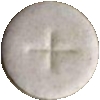
Easter, for Christians, is the special time to celebrate the passion of Christ; not only with Easter Eggs and Hot Cross Buns.
The Crucifixion happened around the time of the Jewish Passover, commemorating the Hebrews' escape from enslavement in Egypt hundreds of years earlier. Passover traditions include the consumption of unleavened bread, and Jesus distributed the same to His disciples at the Last Supper.
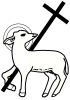
The Passover celebrations also included the sacrifice of lambs. (Hebrew slaves in Egypt marked their doorposts with the blood of such sacrifices so that the angel of death would pass-over their families.) Similarly, mankind can be saved from spiritual death through the blood spilled by Jesus through His sacrifice on the cross (see Meaning of the Cross).
So both the timing and the symbolism of the Passover have a strong connection with the Crucifixion and Resurrection of Christ. For the Pagan Easter customs, where hares and eggs have been symbolised new physical life, the Christian Easter celebrates the new spiritual life.
Christians have innumerable other symbols for commemorating Easter, and most of these feature neither hares nor eggs:
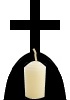


- Paschal Candles light churches throughout the Easter period and the priest may wear special vestments.
- Relics, such as fragments of the True Cross, are particularly revered. The skull and crossbones remind us of the original sin of Adam, which we have all inherited. The cleansing of sin was the purpose of Christ's sacrifice.
- Forty days before Easter, the first day of Lent, some Christian churches celebrate Ash Wednesday by marking the Sign of the Cross on the foreheads of believers, as a reminder of their mortality (hence ash) and penance for their sin (dirt).
- The Crown of Thorns symbolizes the majesty of Christ. The lily also has long associations with royalty and this flower frequently appears on crosses at Easter. (See Fleur de lis Cross and Lily Cross)
- Various implements used in the torture of Jesus, such as nails, can be seen on the Armaments of Christ Cross. These include the cock, dice, hammer, ladder, pincers, chalice, reed sceptre, robe, scourge, spear and sponge.
The cross is obviously the main Easter symbol, and variations include:
- The Palm Cross, used for Palm Sunday celebrations before Easter to remind us of Jesus' processional entry into Jerusalem just a few days before his Crucifixion. The annual re-enactment of this procession is known as the Stations of the Cross
- The Crucifix, showing an image of Jesus suffering on the cross.
- A Titulus, such as INRI is often attached to the cross.
- The Shrouded Cross emphasizes Christ's resurrection from the grave.
- And perhaps the most unlikely Easter symbol, the umbrella!
That's not an eggzorstive list; factorialist.com has eggstra eggzamples you might like to eggzamine.