Southern Cross
a cross of stars
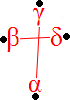
The bottom star Alpha Crucis (Acrux α) is a binary star, with both considerably larger than the sun. To the left is the blue-white star Mimosa or Beta Crucis (Becrux β), the brightest of the group and almost five times the size of our sun. At the top is Gamma Crucis (Gacrux γ) and to the right is Delta Crucis (Decrux δ). Somewhere between Alpha Crucis and Delta Crucis is a smaller star, known as Epsilon Crucis (Ecrux ε)
Top, bottom, left, right, relative size and brightness, are only as we see them from Earth, and of course the orientation depends on your position on Earth. Get a bit closer and you'll see a world of difference. The constellation is a long way away; Acrux, for example, is 1.8 billion, billion miles from earth (320 light years). Becrux is even further, at 580 light years.
Light travels faster than sound. This is why some people appear bright until you hear them speak...
... as Dr Watson found out!
The fact that they are visible to the naked eye shows just how bright these stars are.

They can be seen these days (or rather, these nights) only in the southern hemisphere at latitudes north of 25 degrees. But 7,000 years ago, they would have been visible in Britain. The Greeks revered them and 2,000 years ago could just about see them on the horizon. In the 17th century, the stars were useful night-time navigation points for mariners and explorers. Following an imaginary line defined by the top and bottom two stars for approximately 4.5 times the distance between them, leads to the South Pole.
Unless it's cloudy.
Orion
Also slowly moving south from the celestial equator is the Orion constellation, which has a similar pattern as the Southern Cross, with an additional bright star in the centre.
These five stars have had many mythical interpretations in the past, and today the pattern is printed in semi-secret positions on many of the world's banknotes. This is to hinder scanning them to make counterfeit money. The hardware industry refers to this pattern as EURion, a portmanteau of "Euro" and "Orion".
So in the past, where Orion was named after the Greek god of hunting and known as various gods by different civilisations, it is now named in honour of the God of Money.
National and regional flags that incorporate the Southern Cross
The Southern Cross appears on several national and regional flags and church emblems including:
-
Brazil:
plus Goiás, Paraná, and the logo of the Brazilian Catholic Apostolic Church (BCAC)
- Magallanes Region (Chile)
- Tierra del Fuego (Antarctica)
-
Australia:
plus Australian Capital Territory, Christmas Island, Cocos Islands, Eureka, Greater Melbourne, New South Wales, Northern Territory, Victoria, and the logo of the Anglican Church of Australia (ACA). Australia has made extensive use of it as a national symbol, from cricket to racehorses. They even have a railway station with the same name.
- New Zealand:
plus Niue and Tokelau
- Papua New Guinea:
plus East New Britain, New Ireland Province, Simbu Province, Western Province, and West New Britain
- Samoa

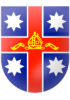
As mentioned at the top of this page, the actual number of stars in the constellation is unknown. If a nation, such as Australia, wishes to show it with five stars in its flag, and New Zealand four stars, neither can claim to be any more correct than the three stars adopted by the Church of the Province of Melanesia.
Political emblem
In addition to the national flags mentioned above, one particular old flag carries the name 'Southern Cross':
Southern Cross
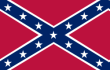
About 150 years ago, the southern states of America attempted to secede from the Union. (The ensuing war was no doubt seen as a good idea by some people, but not by the families and friends of the half a million soldiers who died in battle.) The Confederate's rebel flag had several names, including Rebel Cross, Confederate Cross and Southern Cross.
The design is based on the St. Andrew's Cross, since many residents of the south originated from Scotland, where St. Andrew is the Patron Saint and where the saltire is as common in heraldry as the ancient and noble Celtic thistle.
The colours of the red, white and blue were retained from the Stars and Stripes. The stars represented the eleven states of the Confederacy, plus Kentucky and Missouri.
These days the Confederate battle flag, although a less common sight than a generation ago, remains a symbol of rebellion. Also, because of the South's history of black slavery, the flag is taken up by White supremacists, even outside the US.
Thompson stated:
Many feel the adoption by White supremacists dishonours the flag and as with all symbols, it is liable to multiple interpretations. The flag can traumatise African Americans, and label those carrying the flag as backwater hicks.
The cross on this flag is also called the Starry Cross or Starred Cross, which should not be confused with the Star Cross which is a cross combined with the Star of David.
 Flag of the Ukrainian outlawed New Russia Party
A similar flag has more recently been created by rebels in the former colonial Russian region (1764–1873) of Novorossiya (New Russia) in Ukraine.
Bearers of this flag despise the West and the US in particular. Their flag is not modelled on the Confederate flag; rather it is copied from the Russian naval flag and carried by Tzarist imperialists.
Like the battles in the southern states of America, the war is no doubt seen as a good idea by some people, but not by the families and friends of those who die.
| See also: | Northern Cross Eastern Cross Western Cross |
| and | Crosses on flags |
As if a flag has feelings that could be hurt!
See the BBC's story of Amir Hussain Lone, the most remarkable cricket captain!
Daily Morning News, Savannah, Georgia. 23 April 1863
See Racist pillars of the Church, a brief discussion on why some still believe White supremacy is God's will.