St. Patrick's Cross

Who was St. Patrick? And why was the red saltire chosen?
Patrick was born in Kilpatrick, Scotland (other accounts say somewhere in England or Wales), in the year 387 (or 371 by other accounts). He lived a remarkably long life; some sources say he was 73 when he died, others say he was 106, and yet other accounts age him to 122!
Why is there such disagreement in age? Why is this non-native the patron saint of Ireland? Why is the red saltire associated with him? (See also Who was St. Patrick?)

The red saltire on a white ground probably comes from the coats-of-arms of aristocrats such as the FitzGeralds or the Duke of Leinster.
As an honour to senior Irish peers, the 'Most Illustrious Order of Saint Patrick' was founded in 1783 by King George III. From that date, a red saltire on white ground became known as 'St. Patrick's Cross'. The design was the heraldic arms of the highest-ranking member of the Irish aristocracy and founding member of the Order, the Duke of Leinster.
The red saltire was not, however, a national flag of Ireland. Until the establishment of the Irish Free State in 1922, the flag for Ireland was usually green with a golden Cláirseach (harp).

Jersey
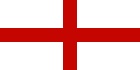
St. George

St. Andrew

St. Patrick
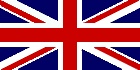
Union
The red saltire is used for the flag of the US State of Alabama, on the old Spanish Cross flag of Burgundy (1506-1785) and on the current flag of Jersey (which also includes the arms of Jersey).
St. Patrick has no particular connection with this small island to the south-west of Britain. The traditional belief is that Jersey, along with its neighbouring islands, was granted neutrality by Papal Bull during one of the dozen or so wars between England and France. Since Jersey was able to trade freely with both sides, they rotated the English St. George's Cross to form a red saltire, thereby differentiating their ships from English ships.
The saltire is used on many other national flags. As a white cross on a blue ground, it is known as St. Andrew's Cross and seen on the flag of Scotland. This was merged with the St. Patrick's Cross and England's St. George's Cross, to make the United Kingdom's Union Flag ('Union Jack').
Whilst Patrick did much of his ministry in Ulster, he is a Catholic saint and therefore shunned by many of today's Loyalists in Ulster. Rather than the St. Patrick's Cross, they prefer the Orange Cross.
-Main source: New Advent Catholic Encyclopedia
-See also St. Brighid's Cross
-Short History Channel video: historychannel.com/exhibits/stpatricksday/?page=video.
See also:


