Evangelists' Cross & Lotus Cross


One of the four cross arms
This page however, introduces an alternative design (shown on the left) of four lotus designs, which could also qualify for the name Evangelists' Cross.
Nasrani

CNI

MTSC

Lotus

Khanda
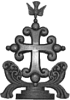
The interpretation of this pattern was initially a mystery; quite possibly just another so-called 'gothic' cross (see Dracula Cross) but could also be relate to Hinduism, Buddhism and Jainism. It forms the basis of the Khanda, an important symbol of Sikhism.
In Christianity it appears in the logo of the Syro-Malabar Catholic Church (Nasrani), the Malankara Mar Thoma Syrian Church (MTSC), and whilst the chalice is central to the Church of North India (CNI) logo, a lotus forms the background of the cross.
The cross featured on this page first appeared in our puzzle section for a few months with a request for ideas, from where Derek Wood of England kindly suggested the arms represent quill pen nibs, and by extension, scribes. And since there are four nibs forming a Christian cross, they can represent the four Evangelists; Matthew, Mark, Luke and John. These Evangelists were tasked with spreading the Good News and are taken to be the authors of the four Gospels in the New Testament.
The winged images shown on the Traditional Evangelists' Cross (shown top left) have been around for some 1,800 years so it cannot hurt to introduce a more modern style. Not that there's anything wrong with the symbolism of the four winged creatures. On the contrary, their meaning and significance is as relevant today as ever. The new version shown on this page makes the point (as pen nibs do) that the Evangelists' accounts were written down and have survived two millennia; a testament to the value placed on the books.
The four Evangelists were quite different people. Their style of writing differs, as does the time and place of writing, the audience and the purpose. And this gives us the benefit of knowing about Jesus' life from four different vectors.
Matthew was a Jewish tax collector and his Gospel was probably written in Syria for a Jewish audience who were familiar with Old Testament prophecy, presenting Jesus as the promised Messiah, the King of the Jews. Mark was a missionary and his Gospel was most likely written in Rome for the Romans. The Gospel of Luke, a doctor, addresses the Greeks, and the account of the fisherman John was written with Gentile Christians in mind.

Looking for a new logo or emblem? Feel free to use the copies we've made of this image: Evangelists Logo
Another Pen Nib Cross

Exactly 150 years before this page was written, Keio University was founded.
Their logo shows two crossed pen nibs with the motto: Calamvs Gladio Fortior (The pen is mightier than the sword. )
Derek has his own website at freewebs.com/... and is moderator for a Pagan bulletin board at uk.groups.yahoo.com/...
'The pen is mightier than the sword' was a line in Act II of Bulwer-Lytton's 1839 play 'Richelieu', possibly inspired by Shakespeare's Hamlet, where courtier Rosencrantz says "...many wearing rapiers are afraid of goose quills and dare scarce come thither."


