St. David's Cross

St. David is the patron saint of Wales. The life of David (Welsh: Dewi or Degui) is found in the Annales Cambriae, written in the 10th century. And given that he was probably born in the 6th century, the accuracy of those records should be treated with a certain amount of caution. Nevertheless, they are the earliest records we have and therefore used as the definitive account of his life.
The leek is a symbol of Wales and this vegetable is usually depicted in paintings of David. It is said that during a battle against the Saxons, the Welsh fighters followed David's advice to identify themselves on the battlefield by wearing a leek in their hat. During hand to hand combat, it must have been difficult to prevent the leek from falling off the hat, or even keeping a hat on one's head. Who knows - maybe this was a cunning plan of the Welsh warriors to slay the Saxons who just stood there laughing. (If you know of another reason for the leek to be the national vegetable of Wales, please let us know.)
Another amazing story is of the dove, which is often seen perched on David's shoulder. One day whilst preaching a sermon at Llanddewi Brefi, the ground on which he stood miraculously rose up so that the crowd could see him. Also, a dove with a golden beak flew to David and settled on his shoulder. The dove is described in the Bible as a symbol of the Holy Spirit.
He was canonized by Pope Callistus II in the year 1120 and during the Middle Ages, two pilgrimages to Ty Ddewi (St. David's, Pembrokeshire) where David became abbot, was the equivalent of one pilgrimage to Rome.
David is the patron saint of doves and as mentioned above, he is also the patron saint of Wales. Interestingly, David is the one and only patron saint of Wales. Even remedies for repetitive muscle contraction, 'Against Twitching', has more than one patron saint (Bartholomew and the Apostle Cornelius) and 'Gout' has ten patron saints. This implies that either Wales is not a very significant place, or St. David is very significant.
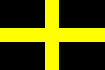
St. David's Flag (Baner Dewi Sant)

St. Petroc, Devon

St. Piran, Cornwall

Welsh Flag (since 1959)
The St. David's Cross appears as a flag, but that is not the official flag of Wales. It is similar to the St. Petroc's Flag of Devon and also in southwest England, the St. Piran's flag of Cornwall which represents the Cornish tin mining. (Not to be confused with the Cornished Cross.) The St. David's Cross is coloured gold - and there's no colour more striking than black to emphasize the gold colour. The flag's colours are believed to have originated from the armorial banner of St. David.
St. David's death is remembered each year on 1 March. Usually at that time, spring daffodils appear and traditionally children in Wales carry golden daffodils and wear the national Welsh costume with its black hat on St. David's Day. The daffodil is the national flower of Wales and symbolises chivalry. The Welsh for 'daffodil' is Cenhinen Pedr which is not far removed from the Welsh for 'leek' - Cenhinen.
The flag has no official status but is used by establishments such as Cardiff City Football Club, Welsh Anglican churches (until 1954 - now the Church in Wales uses a Celtic Cross) and the University of Wales, formerly known as St. David's University College, which began using these colours on scarves and ties in 1888.
The St. David's Cross is not included on the United Kingdom's Union Flag (and neither is the Welsh flag of a Red Dragon) because when the first Union flag was designed in 1606, Wales was regarded as a principality (of the English kingdom). The same still applied when the Union flag changed in 1801.
'Black gold' is a colloquialism for coal, which was a major industry in Wales for hundreds of years, particularly since the Industrial Revolution, until the late 20th century.


In addition to the story about Welsh warriors wearing a leek in their hat (see above), there's a legend that the black stovepipe hats worn by Welsh women helped counter an invasion by Napoleon. The French soldiers saw these women from a distance and mistook them for British Redcoats wearing tall black hats.
From personal experience, having a Welsh wife and a Welsh sister-in-law, I've no doubt that a battalion of Welsh women in black stovepipe hats would be a match for the French Army any day!


