Wavy Cross


On the right we see Pope Francis holding a pastoral staff as he offers Mass on the Italian island of Lampedusa on 8 July 2013. This was his first official visit outside of Rome.
Lampedusa is to where thousands of refugees from Tunisia and elsewhere in Africa arrive every year seeking a better life in Italy and in the rest of Europe. (Three months after this Mass, a boat carrying refugees from North Africa capsized in the area, killing most of its 500 passengers.)
At the Mass, the pope stood behind a small boat and said prayers for the unknown number of refugees who had arrived over the years, and for the unknown number of refugees who had perished on the journey.
Also on the dais was flotsam from shipwrecks – boats that were supposed to lead the refugees to a better life, but led to a gruesome death. The pastoral staff was made from the wood of boats used by migrants to make the crossing.
The white and blue colours in Roman Catholicism symbolise purity, virginity, innocence, virtue, holiness and grace. The Virgin Mary is often depicted wearing white and blue clothing, but for this cross, the colours have an additional purpose.

Boats that are used to smuggle refugees are often painted white and blue as camouflage to avoid detection by the Italian coast guard, whose job it is to detect people trying to enter the country illegally. (If the boats were painted orange perhaps fewer would die.)

The Miracle of the Loaves and Fishes, a painting by Lambert Lombard
(Click image to enlarge)
Swimming towards the central red heart of the cross are two fish, carved on the horizontal arms, while five loaves are engraved on the shaft. These depict the miracle Jesus performed with the loaves and fish.
In the same passage of the Gospel we read again the virtue of sharing that allows the multiplication from the little that you have with those in the community, whether they are known to you, strangers or immigrants.
The heart in the centre of the cross reminds us that love and charity is central to the Christian faith and must be part of our everyday life.
At the Mass the pope used a wooden cup and a nail cross at the base of the chalice, material also salvaged from migrants' boats, and like the staff, made by local artesans.
And the wave?
No, the wave is neither a hip hop arm wave nor a trigonometric sine wave. Calling this a Wavy Cross is more than simply describing the shape of the cross bar, and more than just describing the sea waves that terrorised migrants in their overcrowded and poorly maintained boats as they cross the Mediterranean Sea.
The Wavy Cross can be said to symbolise the water of baptism, and the fish represent the faithful, swimming towards the central heart, which represents Jesus.


This last one, which we'll call a Distorted Cross, was noticed on the Bayeux Tapestry. That's the famous 11th century cartoon strip telling the story of the Norman invasion of Saxon England, and the cross was either Norman, Saxon, both or neither.
Nobody knows who embroidered the 70 metre (230 foot) long Tapestry, but it was probably done in England by an Anglo-Saxon artist or seamstress. The artist is no more likely to have been on the battle-field than either the Bishop Odo of Bayeux or the Queen Matilda, the possible commissioners of the work. The caricature and surreal nature of the Tapestry shows exaggerated poses of the warriors and their shields.
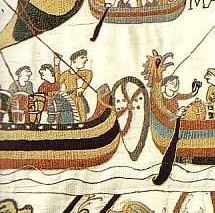

The Distorted Cross can be seen on the shield hanging from the stern of the Norman boat crossing the Channel to Hastings. The Normans attacked on horseback and favoured the kite-shaped shields to protect their legs. This cross therefore was initially assumed to be a Norman design.
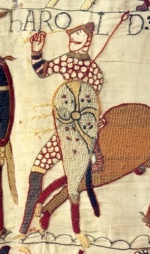
"I spy with my little eye, something beginning with A"
And yet in the picture on the right we see King Harold, with a distinctive Saxon moustache, plucking the arrow from his eye. Harold was the English king, so what was he doing with a Norman shield if indeed it was a 'Norman Cross'? The Saxons, though they used horses to reach the battle field, fought on foot and used round shields.
We've been fortunate in getting answers to these questions from a historian at Reading museum that houses the only full-size replica of the Tapestry.
Shields are designed to withstand a fair battering and were traditionally reinforced with iron cross-pieces. Shields were also curved to slightly wrap around the bearer's body offering some protection against blows from the side. The curves of the iron cross-pieces are following the curvature of the shield. This is why we see the design used by both Saxons and Normans.
(See also Bent Cross and Norman Cross)


