Thugsta Cross

But then we discovered that it has a much wider global reach.
At first sight, this cross looks like a voided patty.
'Patty' is the term used to describe a cross with arms which are narrow in the centre and broad at the ends (see Pattée Cross). When only the edges of the arms are traced, it is termed 'voided'. A Voided Cross is usually shown with a border completely surrounding the cross, but in this case, the arms ends are open.


Open-ended arms are not especially rare. Examples include the logos for the Canadian Conference of Catholic Bishops and the Church of the Brethren (COB), shown on the right.

Gamma Cross
If the lower arm was shorter, so that all four arms have equal length (quadrate), then it could be interpreted as an arrangement of four 'L' shapes, forming a Gamma Cross.
So much for heraldry. But what does this cross mean?
Well, in a Christian context, the meaning of the Cross is well understood. And there is little doubt that the cross featured on this page is Christian. A Voided Cross reminds us that Christ rose from death on the cross to proclaim His victory over sin, death, and the Devil (see Voided Cross.)
Describing this cross is easy. What is eluding us is the origin of this particular design. The image was spotted in the obituary column of a Swedish newspaper, which initially led us to speculate the design may be the symbol of a Nordic church or society.
A kind email from Christopher in the UK pointed out that a quadrate version of this cross is found in the emblem of De Haan, a hamlet on the Belgian coast, which for a short time was the home of Albert Einstein. (See dehaan.be)

Flag of De Haan, Belgium (Click image to enlarge)
The red/white/green bands of this flag represent the three former municipalities which merged to form De Haan in 1976. All three municipalities had a Templar Cross in their coats of arms, and the red cross in the centre of the flag is representative of all three. The cross is officially described as a 'voided pommety', that is, there are eight small discs at the arm ends (see Pommee Cross) rather than the triangular tips of the cross we introduce above.
But given the relatively close proximity of Belgium and Sweden, it is quite possible that the cross in the obituary column has some connection with the cross of De Haan.
Why "Thugsta"?
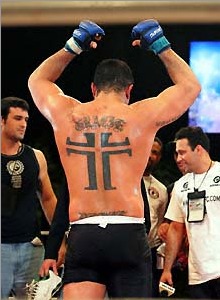
Ryan Gracie, after beating Ikuhisa Minowaman in May 2004 (split decision result)
Moving away from Northern Europe to South America, we see a similar design tattooed on the back of Ryan Gracie, a Brazilian mixed martial arts fighter from Rio de Janeiro who tragically died in 2007. (We are indebted to Ryan's cousin and a close friend for providing the following information.)
Ryan had a black belt in Brazilian Jiu-Jitsu and was a member of the Gracie family, internationally famous in the world of Jiu-Jitsu. Catholicism is the main religion in Brazil (about 75%) but Ryan is not known to have been devoutly religious.
The tattoo was done by Mojo in Sao Paulo and is in fact is a stylised letter 'T', not a cross. The 'T' was to be the logo patched on Jiu-Jitsu uniforms with a brand label called 'Thugsta'. Ryan had planned to produce a line of fighters' wear with this Thugsta Inc. brand.
The name was derived from the ruthless tough guy term 'thug', together with the mid-1980s term 'Gangsta', a sub-genre of hip hop reflecting the violent wannabe gangster lifestyles of some inner-city youths in the United States. Many might dismiss such behaviour as being absurd and childish; just as many dismiss tennis, golf and bowling as absurd and childish. Nevertheless, there's no doubt that the name 'Thugsta' has a more aggressive appeal than 'Lululemon' or 'The North Face'.

There's a patriotic similarity between Ryan's Thugsta Cross and the Order of Christ Cross seen on this upright orientation of the state flag of his home city São Paulo.
Ryan first had the design tattooed with the names 'GRACIE' above the 'T' and 'DEVIL' way down below. He later had 'GOD' tattooed above that.
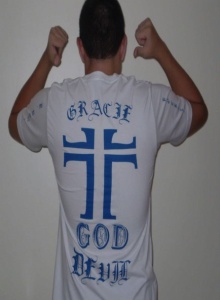
Ryan's friend sent us the photo on the left, where he's wearing a tee shirt with the 'arms' of the 'T' modified to accommodate his bulging biceps.
All journalists know that 'Bad News Sells Better Than Good News', but Ryan's friend confirms that "...he was a great guy. There are a lot of stories about him but I never saw the bad side."
It's true that many negative things have appeared in print about Ryan's life; a price many celebrities pay.
So despite the tattooing of 'God' and 'Devil', the Thugsta Cross is not a religious symbol. There is no 'Saint Thugsta' and the design is not even supposed to be a cross.
It is a symbol representing finely tuned fighters who have excelled in their sport. It is a symbol proudly worn in memory of their friend, Ryan Gracie, whose fighting days are over.
May he rest in peace.
Other Cross Tattoos
Jiu-Jitsu is a distant relative of Jujutsu, an ancient Japanese martial art intertwined not so much with Buddhism or Shintoism, but more of a philosophy. Rather than attacking and opponent, the Jujutsu practitioner yields to an opponent's force and manipulates it to control the attacker's balance. The successful Jujutsu warrior has a clear mind (zanshin), enabling him to be constantly alert (mushin) for opportunities, which is particularly difficult when a carotid artery hold disrupts the blood supply to the brain!


